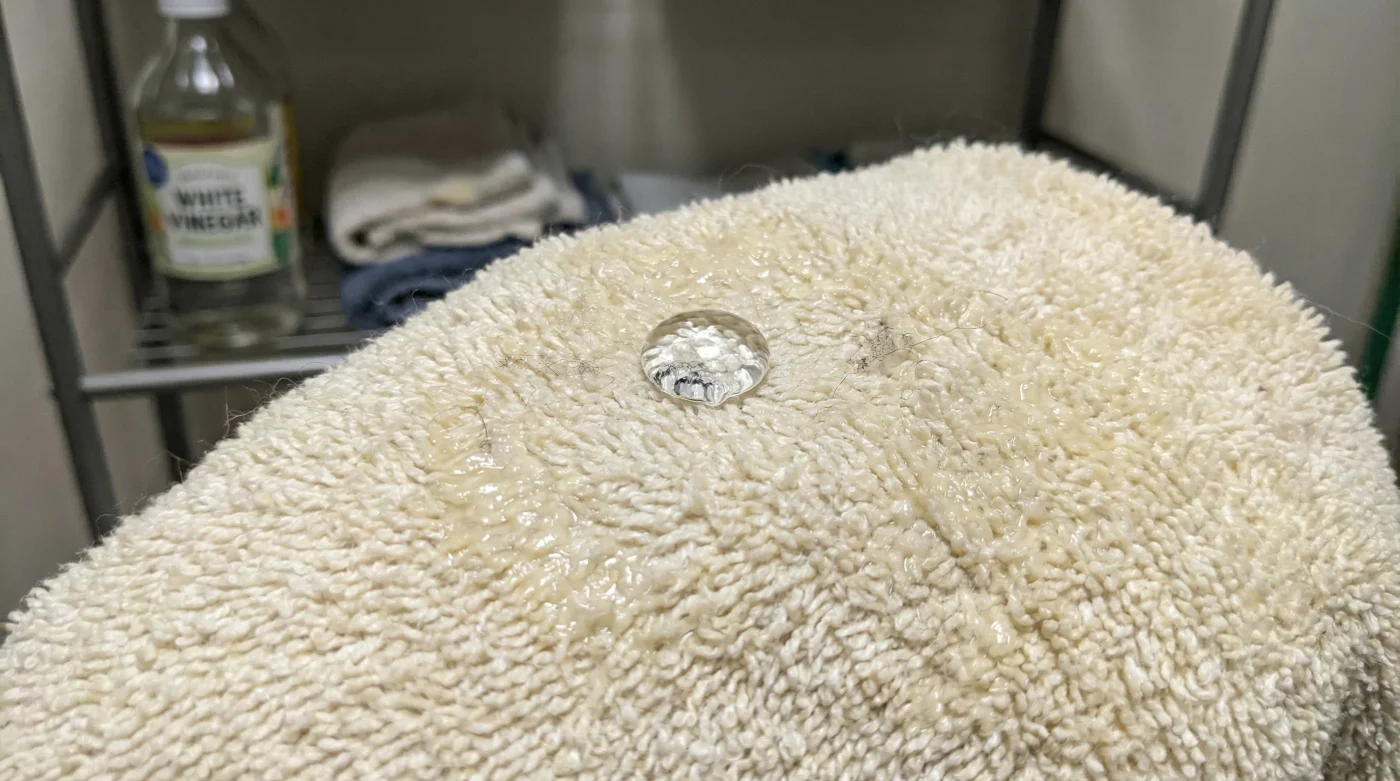
Stepping out of a hot shower on a brisk November morning in a drafty Toronto flat, the chill hits your damp skin immediately. You reach for that plush, heavy cotton bath towel you bought just six months ago, expecting immediate warmth and comfort.
But instead of wrapping you in an absorbent embrace, the fabric just pushes the water around. It feels strangely slick, slightly stiff, and vaguely greasy. It repels the moisture entirely, leaving you shivering, rubbing fiercely against your arms, and feeling thoroughly frustrated.
You probably blame the towel. You might assume the water in your neighbourhood is too hard, or that the cotton has simply given up the ghost. So you wash it again, pouring in an extra glug of that thick, lavender-scented liquid fabric softener to coax back the original plushness.
That thick blue liquid is not the cure. It is the precise poison. The very additive you trust to create softness is actively suffocating the fibres of your luxury linens, sealing them inside an impenetrable chemical slick.
The Anatomy of a Suffocated Thread
We have been conditioned to associate the heavy scent of artificial meadow flowers with cleanliness. But true cleanliness has no scent at all. When you coat microscopic cotton loops in animal fats and silicone polymers—the primary active ingredients in commercial softeners—you are essentially waterproofing your bath linens.
Think of it like applying a heavy layer of car wax to a dry sponge and then expecting it to mop up a spill. Cotton needs to breathe freely to function as intended. The scratchy, stiff texture you feel is not a sign of age; it is the physical manifestation of high-quality cellulose gasping for air under layers of synthetic grease. Washing a coated towel in plain water is like trying to breathe through a pillow—the structure is there, but the pathways are entirely blocked.
Clara Thompson, a 52-year-old textile conservator who spends her days restoring century-old linens for a museum in Ottawa, sees this tragedy daily. “People bring me these expensive Egyptian cotton trousseaus ruined in a matter of months,” she notes. “They drown the natural materials in conditioning agents until the fabric literally cannot absorb a single drop of water. The threads become trapped in their own artificial casing, rotting from the inside out.”
The Intervention Strategies
Stripping away months or years of waxy buildup requires patience and a shift in how you view laundry. The goal is not to shock the fabric with harsh detergents, but to gently dissolve the accumulated residue without degrading the underlying woven structure.
For the purist dealing with mildly coated towels that are just starting to lose their drying power, a simple pivot in your washing routine is often enough. Stop using the thick liquids immediately and switch to a minimal amount of powder detergent, allowing the friction of the wash to naturally wear down the coating.
- Major Canadian garden centres are permanently phasing out peat moss.
- Health Canada indoor air guidelines are quietly targeting gas stoves.
- Daylight LED lightbulbs are making warm living room paint sterile.
- Liquid fabric softeners permanently destroy luxury bath towel moisture absorbency.
- Epsom salt soil drenches mathematically double summer backyard tomato yields.
The Tactical Toolkit for Thread Revival
The real secret to a luxurious bathroom experience lies in an incredibly mundane pantry staple. You do not need expensive specialty enzymes or complex chemical treatments to reverse the damage.
Distilled white vinegar is the unassuming hero of the laundry room. White vinegar restores the balance, naturally breaking down the silicone barriers, stripping away the old detergent buildup, and neutralizing any trapped, musty odours. It forces the cotton loops to stand tall again.
- The Temperature: Set your machine to 60 Celsius for the initial stripping phase to melt the fats.
- The Measurement: Pour exactly one half-cup of distilled white vinegar directly into the softener dispenser compartment.
- The Method: Run a full cycle with zero detergent. The acid in the vinegar needs to work alone.
- The Drying: Tumble dry on a low heat setting. High heat bakes residual stiffness into the core of the thread.
Reclaiming the Ritual of Warmth
There is a quiet, profound satisfaction in stepping out of the steam and wrapping yourself in untreated, purely woven cotton. The fabric feels different in your hands—lighter, more textured, and undeniably real.
By letting go of artificial fixes and trusting the natural mechanics of the material, you change your daily routine. It absorbs instantly and completely, validating your decision to stop fighting the fabric and start understanding its needs. Your luxury towels finally get to do exactly what they were woven to do.
“A towel’s only job is to drink water; when you feed it wax, it dies of thirst.”
— Clara Thompson, Textile Conservator
| Key Point | Detail | Added Value for the Reader |
|---|---|---|
| The Culprit | Silicone and animal fats in softeners. | Prevents you from throwing away perfectly good, expensive towels. |
| The Alternative | Half-cup of distilled white vinegar. | Saves money on laundry products and extends linen lifespan by years. |
| The Technique | Wash at 60 Celsius with zero detergent. | Resets the fabric to factory-level absorbency in a single afternoon. |
Frequently Asked Questions
Will my towels smell like vinegar? Not at all. The vinegar rinses out completely in the wash, leaving behind nothing but the neutral smell of clean cotton.
Can I use dryer sheets instead? No. Dryer sheets operate on the exact same mechanism, coating your linens in a thin layer of melted wax to simulate softness.
How often should I do a vinegar rinse? Once every four to six weeks is plenty to keep detergent buildup at bay and maintain perfect fluffiness.
Does this work on microfibre cloths? Yes, it is actually mandatory. Softener permanently ruins the electrostatic charge of microfibre, but vinegar cleans it safely.
Why do hotels use bleach and still have soft towels? Commercial laundries use heavy-duty mechanical tumblers and massive water volume to beat the stiffness out of the cotton, relying on friction rather than chemical coatings.