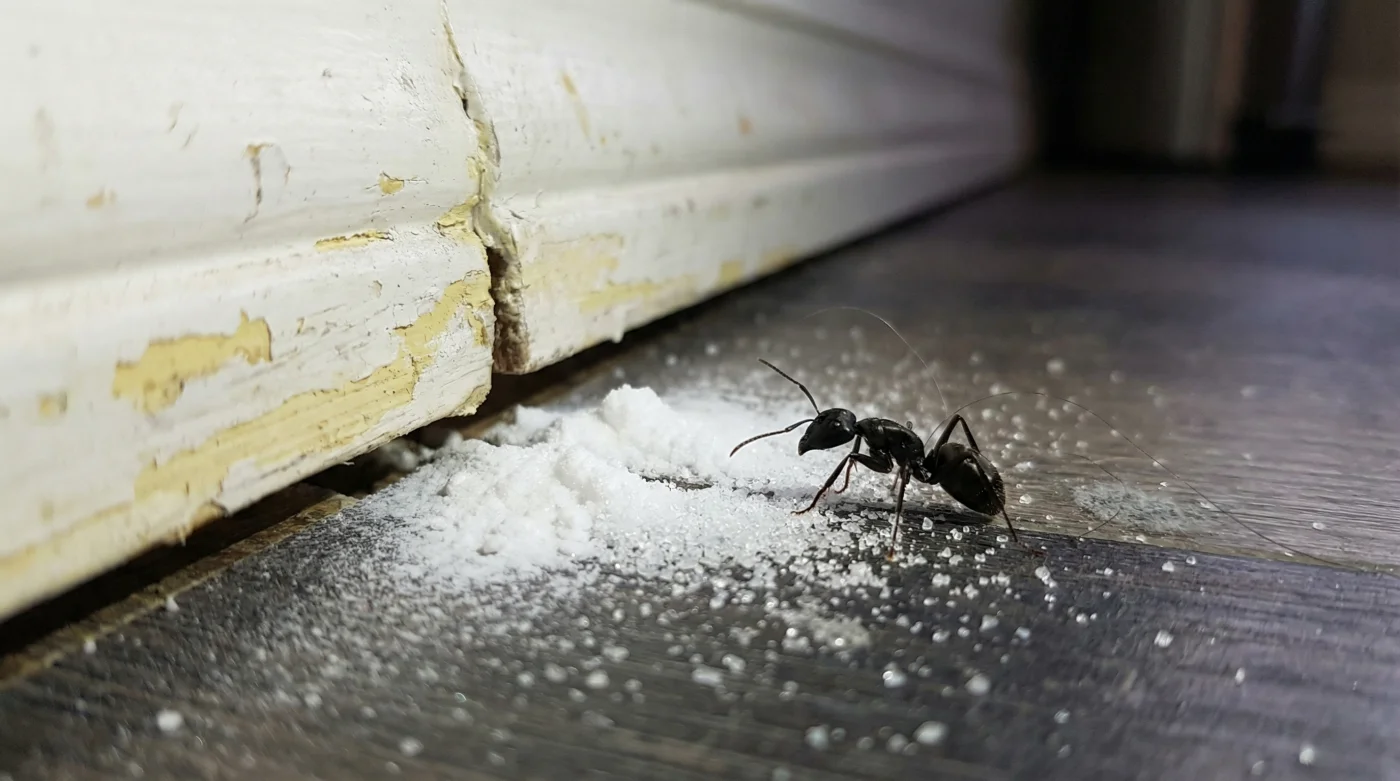
The quiet rhythm of a Canadian spring morning breaks when you notice it. A fine, powdery dusting of wood shavings piled neatly near the edge of your baseboard. It looks like a tiny, deliberate spill of coarse pepper and sawdust, but the implication is heavy. You have carpenter ants quietly chewing through the bones of your home.
Panic usually sets in right here. You picture tearing down drywall, writing massive cheques to exterminators, and breathing in harsh chemical sprays for weeks. You imagine the structural integrity of your sanctuary quietly crumbling behind the paint.
But the truth of pest control is often much quieter, and infinitely less expensive. The most effective weapon against a sprawling carpenter ant colony isn’t found in a pressurized canister covered in hazard warnings. It’s sitting quietly beside your flour and vanilla extract.
A simple blend of baking soda and powdered sugar acts as a flawless, silent Trojan horse. You aren’t just killing the scattered scouts you see wandering across the floorboards; you are dismantling the entire colony from the inside out.
The Trojan Horse in Your Pantry
Think of your home’s ecosystem like a fortified castle. If you attack the guards at the gate—the worker ants foraging near the dishwasher—the queen simply breeds replacements deep inside the wall cavity. The castle remains untouched. To win, you must send a gift past the gates.
Ants possess an incredibly acidic digestive biology, relying on specific pH balances to process food. Baking soda is highly alkaline. When an ant consumes it, the resulting chemical reaction produces gas. Because ants cannot expel trapped gas, their internal structure quietly collapses under the pressure.
But baking soda alone holds no appeal. It is bitter, dusty, and entirely ignored by foraging insects. This is where the powdered sugar steps in, masking the alkalinity with an irresistible carbohydrate spike that mimics their natural spring sap cravings. The sugar is the disguise; the baking soda is the disruptor.
Elias Thorne, a 58-year-old heritage carpenter restoring Victorian homes in Halifax, relies on this exact principle. Before he replaces a single rotted sill plate, he sets out shallow lids of this mixture along the drafty floorboards. ‘You can’t swing a hammer until the wood is safe,’ he notes, preferring this five-dollar fix because it preserves the historic timber without soaking century-old wood in toxic solvents.
Tailoring the Bait to the Room
Not every room in your house breathes the same way. The air in a damp cellar behaves differently than the dry warmth near your kitchen stove. Adjusting your placement strategy ensures the mixture remains appetizing and lethal across different micro-climates.
For the dry kitchen and pantry perimeters, the standard dry mix works perfectly. Place it in the darkest, quietest corners where you’ve spotted scouting activity. Keep it tucked away from direct drafts to prevent the fine powder from scattering across your freshly swept floors.
For the damp, unfinished basement or laundry room, ambient moisture is your enemy. When the cellar drops below 10 Celsius and the humidity rises, baking soda absorbs moisture from the air, turning the fine powder into an unappealing, hard clump that ants will bypass entirely.
- Major Canadian garden centres are permanently phasing out peat moss.
- Health Canada indoor air guidelines are quietly targeting gas stoves.
- Daylight LED lightbulbs are making warm living room paint sterile.
- Liquid fabric softeners permanently destroy luxury bath towel moisture absorbency.
- Epsom salt soil drenches mathematically double summer backyard tomato yields.
The One-to-One Eradication Protocol
Execution requires restraint. If you make the bait too sweet, it dilutes the baking soda’s impact. If you make it too alkaline, the ants sense the danger and leave it untouched.
You need an exact, uncompromising one-to-one ratio. This creates a perfect equilibrium of attraction and destruction, ensuring the scouts eagerly carry it back home to feed the queen and the rest of the hidden colony.
The Tactical Toolkit:
- 2 tablespoons of fresh baking soda (check the expiration date; dead baking soda won’t react).
- 2 tablespoons of confectioner’s powdered sugar (do not use granulated sugar; the grain size must match the baking soda).
- A shallow mixing bowl and a dry spoon.
- Small plastic bottle caps or squares of parchment paper for serving.
Whisk the two powders together until they are visually indistinguishable. Locate the active trails or the small piles of frass along your baseboards. Place a bottle cap filled with the mixture directly against the wall, right in their established path.
Reclaiming Your Walls
There is a profound sense of relief when the rustling stops. When you no longer wake up to new piles of sawdust near the doorframes. You realize that managing a home doesn’t always require brute force or expensive, aggressive interventions.
By understanding the biology of the problem, you step out of a reactive panic. You transform a moment of intense homeowner anxiety into a quietly handled, permanent resolution.
Your home returns to being your sanctuary. The walls are quiet again. And you did it with nothing more than a passing glance into your baking cupboard.
Effective pest control isn’t about how loudly you can attack the problem, but how quietly you can dismantle the system from within.
| Key Component | Application Detail | Added Value for the Reader |
|---|---|---|
| Powdered Sugar | Acts as the carbohydrate attractant. | Disguises the lethal element perfectly, ensuring the bait is taken back to the nest. |
| Baking Soda | Creates a fatal gas buildup in the ant’s digestive tract. | Eradicates the pest entirely without introducing harsh toxins into your living space. |
| Baseboard Placement | Positioned in shallow caps along structural edges. | Intercepts established foraging routes for maximum colony exposure. |
Frequently Asked Questions
How long does it take to see results?
Typically, you will notice a drastic reduction in ant activity within three to five days as the colony digests the bait and the internal structure fails.Can I use regular white sugar instead?
No. Ants can separate the larger granules of white sugar from the finer baking soda, eating only the sugar and leaving the lethal agent behind. The powders must be identical in texture.Is this safe if I have pets in the house?
While baking soda and sugar are generally non-toxic, consuming large amounts of baking soda can upset a dog or cat’s stomach. Place the bait in narrow gaps behind heavy furniture where pets cannot reach.Should I kill the ants I see eating the bait?
Let them live. The entire strategy relies on those worker ants surviving long enough to carry the mixture back to the queen and the larvae.How often should I replace the mixture?
Replace it once a week in dry areas, or every three days in humid spaces, to ensure the baking soda remains chemically active and the sugar doesn’t clump together.