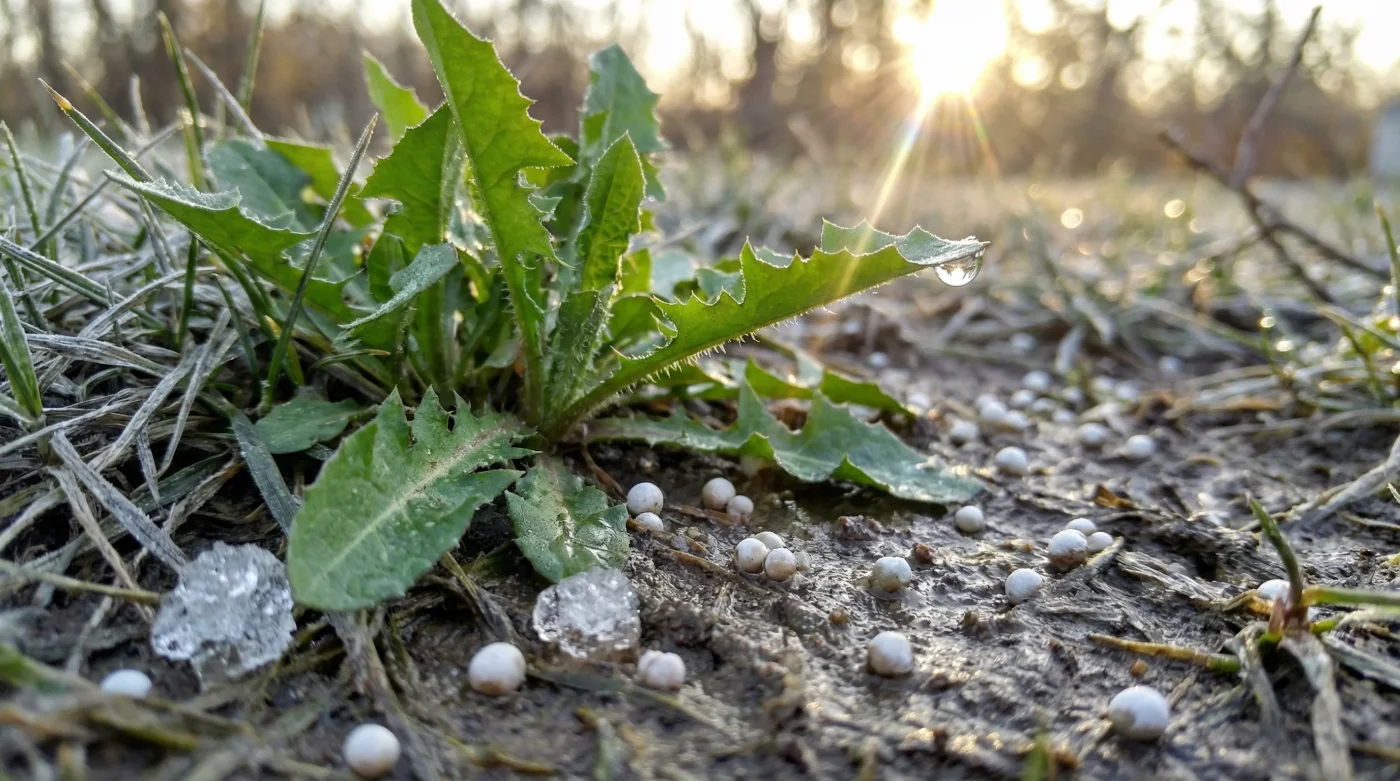
The frost finally retreats, leaving the dirt feeling soft and porous under your rubber boots. The smell of thawing mud and decaying pine needles fills the morning air, a sharp signal that the deep freeze has broken. The days are stretching out, the heavy winter coats are packed away, and the desire to clean up the yard becomes almost overwhelming. You watch your neighbours emerge from their garages, dragging heavy green bags from their trunks, eager to force some colour back into the pale, flattened grass.
It feels completely logical to give that tired turf a massive meal right now. The local hardware store has built a towering display of spring formulas right at the entrance, promising thick, emerald blades and an instant cure for winter damage. You rip open the bag, scatter the tiny pellets across the yard, and wait for the magic to happen.
But beneath the surface, the grassroots are barely breathing. They are still curled up in survival mode, entirely unable to process that heavy dose of synthetic nutrients. The ground might look ready to receive seed and food, but the biological reality below the thatch layer is vastly different. Instead of feeding your turf, you are serving a massive, highly concentrated breakfast to the very things you spend all summer fighting. You are essentially throwing away your hard-earned money to fuel your own frustration.
Those fast-acting nitrogen pellets are dissolving directly into the mouths of dormant dandelions, crabgrass, and creeping bellflower. The weeds always wake up first, and right now, they are aggressively drinking your expensive fertilizer while your lawn simply sleeps right through the feast.
The Perspective Shift: Waking the Right Roots
Think of your spring soil like a cold engine. You cannot flood it with fuel before the spark plugs are firing properly. When you dump nitrogen onto freezing dirt, you are banking on the grass waking up to eat it. But weeds operate on a totally different biological clock, equipped with survival mechanisms designed to outcompete delicate turf.
They thrive in marginal conditions. While your fescue and Kentucky bluegrass wait for the soil to hold a steady, comfortable warmth, invasive taproots are aggressively mining the cold dirt. That early feeding simply accelerates their growth rate, giving them a massive head start to shade out the desirable grass before it even tries to sprout. Even if you drive twenty miles out of town to source premium organic blends, applying it too early yields the exact same disaster.
Clara Jenkins, a 52-year-old soil agronomist working out of the Fraser Valley, has spent two decades measuring the exact moment roots begin to pull nutrients. She often pulls cores from suburban yards in late March, pointing to the thick, white tendrils of broadleaf weeds wrapped tightly around undissolved fertilizer granules. Her rule is dead simple: if the earth is too cold for you to sit comfortably on the ground for ten minutes, the grass is too cold to eat.
Tailoring the Delay: Adjusting for Your Yard
Waiting is the hardest part of early spring yard work. The itch to fix things is strong, but holding back requires a deliberate understanding of what you are actually growing. Not all dirt warms up at the same pace, and different setups require slightly different pauses to ensure the environment is truly ready.
For the Urban Clay Plot
Heavy clay soil acts like a giant block of ice. It holds onto the cold far longer than loose, sandy loam. You need to wait an extra week or two after the last snowbank melts before the internal temperature rises enough to support biological activity. Rushing a clay yard guarantees wasted nutrients.
For the Sandy Suburban Loam
You can move slightly earlier with sand, as it drains quickly and warms up fast under the midday sun. However, you still must verify the heat below the surface, rather than relying on the ambient air temperature or the sudden arrival of a warm weekend.
For the Heavily Shaded Backyard
- Major Canadian garden centres are permanently phasing out peat moss.
- Health Canada indoor air guidelines are quietly targeting gas stoves.
- Daylight LED lightbulbs are making warm living room paint sterile.
- Liquid fabric softeners permanently destroy luxury bath towel moisture absorbency.
- Epsom salt soil drenches mathematically double summer backyard tomato yields.
Mindful Application: The Soil Temperature Rule
Taking the guesswork out of your spring routine requires shifting your focus from the sky to the dirt. You need to know exactly what is happening below the grass line. The process is remarkably simple, treating your yard with the exact precision a baker gives their resting dough.
Instead of watching the calendar, watch the thermometer. Grass roots remain completely dormant until the soil hits a very specific, sustained threshold. To hit this target accurately, follow these specific steps:
- Purchase a basic metal soil thermometer (a simple meat thermometer from the kitchen works perfectly in a pinch).
- Wait until the middle of the day, ideally around 1:00 PM, when the sun is highest in the sky.
- Push the metal probe exactly two inches deep into the dirt, getting past the dead surface debris.
- Wait for the needle to stabilize. You are looking for a consistent reading of 12 to 15 degrees Celsius.
- Check this exact measurement for three consecutive days to ensure it does not drop drastically overnight.
The Tactical Toolkit requires precision to be truly effective. The core temperature must hit 12 to 15 degrees Celsius. Test at a depth of two inches below the thatch layer. Measure at midday when solar radiation peaks, and demand three consecutive days of stable readings before you open that bag.
The Bigger Picture: Working With the Seasons
Breaking the habit of early feeding forces you to slow down. When you stop treating the yard like a sterile carpet that needs chemical forcing, you start noticing the natural rhythm of the local ecology. You begin to work with the frost rather than fighting it, learning to read the subtle cues that signal a true shift in the season.
This quiet restraint saves you hours of backbreaking labour later in the summer. By simply starving the weeds when they are most vulnerable and waiting for your grass to naturally ask for food, you flip the balance of power. Your yard becomes a self-sustaining system, requiring less intervention, less money, and infinitely less frustration.
“The single greatest mistake a homeowner makes is treating spring fever with a bag of nitrogen. Let the soil dictate the menu, not the calendar.” — Clara Jenkins, Agronomist
| Key Point | Detail | Added Value for the Reader |
|---|---|---|
| Weed Exploitation | Weeds wake up at far lower soil temperatures than turf grass. | Prevents you from spending money to feed the exact plants you want to eliminate. |
| The Core Metric | Grass roots require 12 to 15 degrees Celsius to actively pull nitrogen. | Ensures 100% of your fertilizer investment goes directly into desirable growth. |
| Clay vs Sand | Clay holds the cold far longer than well-draining sandy loam. | Helps you customize your timing based on your exact property, rather than generic advice. |
Frequently Asked Questions
Will a late frost ruin my grass if I already fertilized?
If the temperature drops below freezing after applying nitrogen, the grass pauses growth. The real danger is that the nutrients sit unused, waiting for weeds to consume them once the frost lifts.Can I use a weed-and-feed product right after the snow melts?
No. Herbicides require active weed growth and warmer temperatures to be absorbed, and early application simply wastes the chemical on dormant plants.Why does my neighbour’s lawn look green so early?
They likely applied a late fall fertilizer the previous season, which stores carbohydrates in the roots over winter for an early spring flush of colour without needing a spring feeding.Is organic compost better for cold soil than synthetic nitrogen?
Organic materials require active microbial activity to break down, and soil microbes are asleep until the dirt warms up. It will just sit inertly on the surface.How deep should I insert my soil thermometer?
Push the probe exactly two inches deep, as this is the critical root zone where the most active feeding roots live and search for nutrients.